


Well, we finally had a couple of warm days here in Chicago, but now it’s chilly again and the Heilung hoodie is back on. Heiling is a group that plays pre-Viking traditional Nordic music and does spectacular live performances. It’s weird, interesting music.
But that’s not what I am here to write about today. I am, unfortunately, going to say more about hospice fraud and the U.S. Centers for Medicare and Medicaid Services’ (CMS) enforcement actions.
CMS has suspended Medicare payments for close to 800 hospices to date, along with a contingent of home health agencies (I should also note that before these measures, the agency also put a moratorium in place for durable medical equipment suppliers, too).
However, in hospice’s case, some of these providers are legitimate and have not been implicated in criminal fraud. Instead, they are largely being targeted based on a single metric — live discharges. Check out our Hospice News coverage here.
We went to some tried-and-true sources for that story – people we have worked with for years. We also got information from CMS, including comments directly from the agency’s administrator, Dr. Mehmet Oz. Finally, we interviewed one of the hospices that received a payment suspension letter, who spoke on condition of anonymity.
Hospice News also got a number of off-the-record comments that we couldn’t publish, but gave second- or third- source confirmation of the details our on-the-record sources told us.
We have a forthcoming follow-up story in the works with additional details.
I thought it would be instructive for our readers to actually see one of the payment suspension letters that CMS’s Unified Program Integrity Contractors (UPICs) are sending out. See it below. While Hospice News only examined one letter, multiple sources confirmed that it fits a pattern — citing live discharges as the reason for the suspension and identifying five patient records. The letter is redacted to remove information that identifies the organization or their patients.
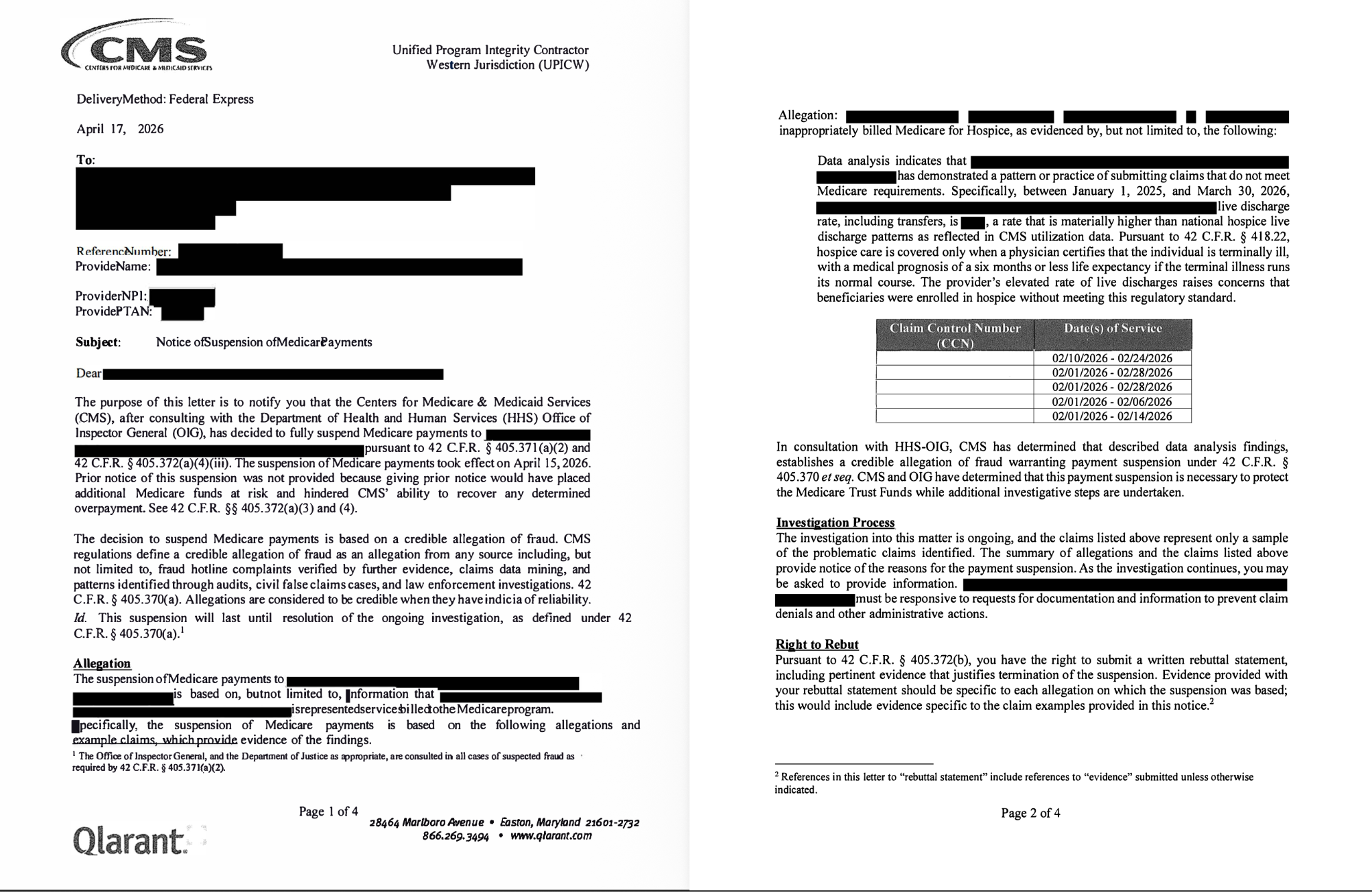
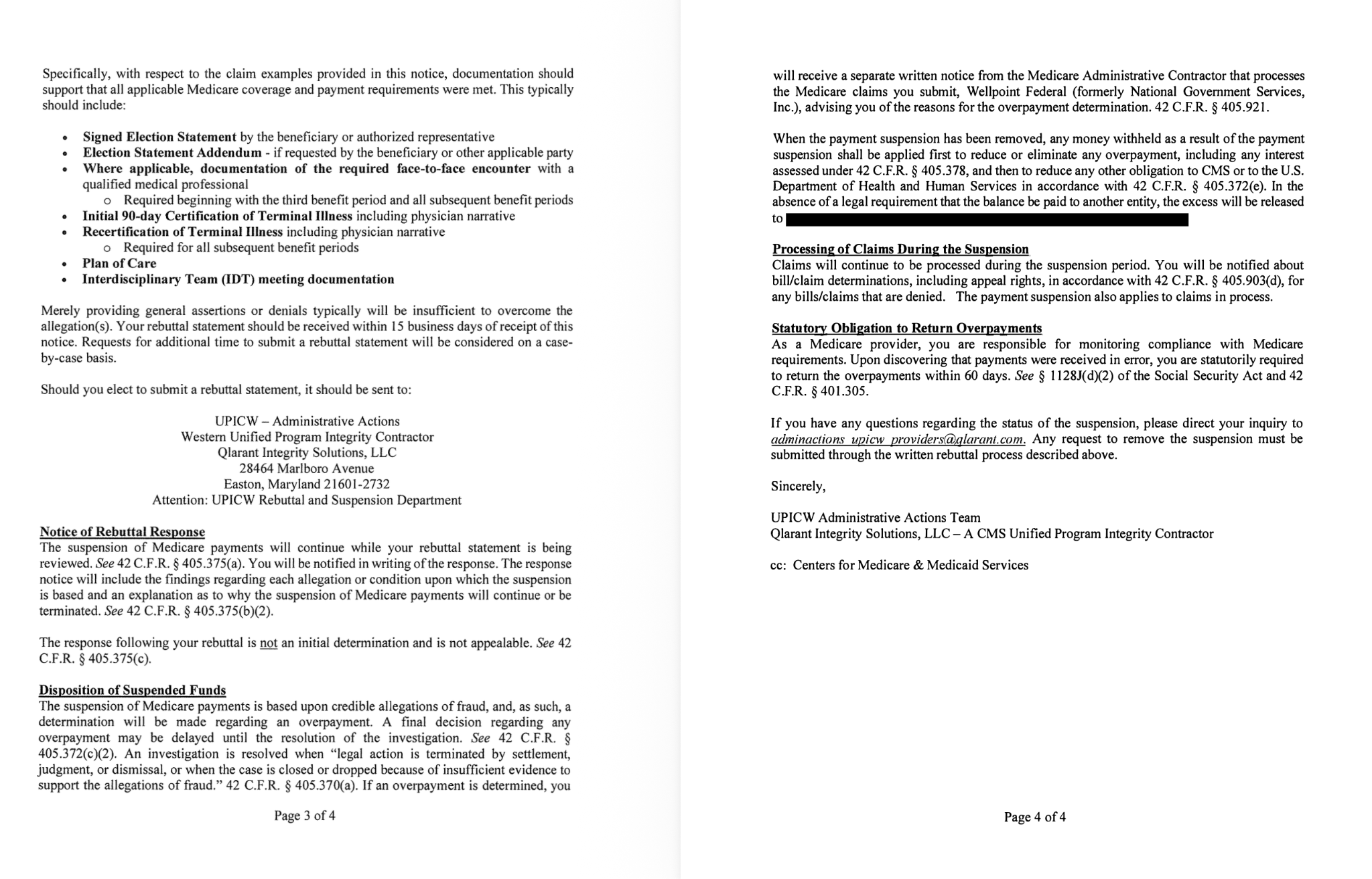
Admittedly, we don’t know exactly how many of the nearly 800 hospices who received these suspensions are legitimate operators, and we have to acknowledge that some fraudulent providers are being suspended or shut down. But multiple sources have told us that the issue is widespread, and legitimate hospices are getting suspensions.
Some are even going out of business as a result.
What’s your take on this issue? Please drop a comment. I would love to hear your thoughts.
"Some are even going out of business as a result."
Objection - stated as fact without evidence
Is there any evidence that they are doing this to hospices in states not in the moratorium?