

Conversations with loved ones about our end-of-life wishes, goals and values are essential, and we must take them seriously. And as hospice providers know all too well, avoiding such conversations can complicate people’s process of transitioning to hospice care.
Therefore, it’s in the interest of providers to promote these conversations. One hospice and palliative care social worker, Lisa Pahl, developed a game with this objective.
In fact, a number of games, usually with cards, have emerged in recent years that are designed to foster those discussions in a thoughtful but entertaining way. I have seen at least three, and I think these games could serve as an interesting tool for families as they think about these issues.
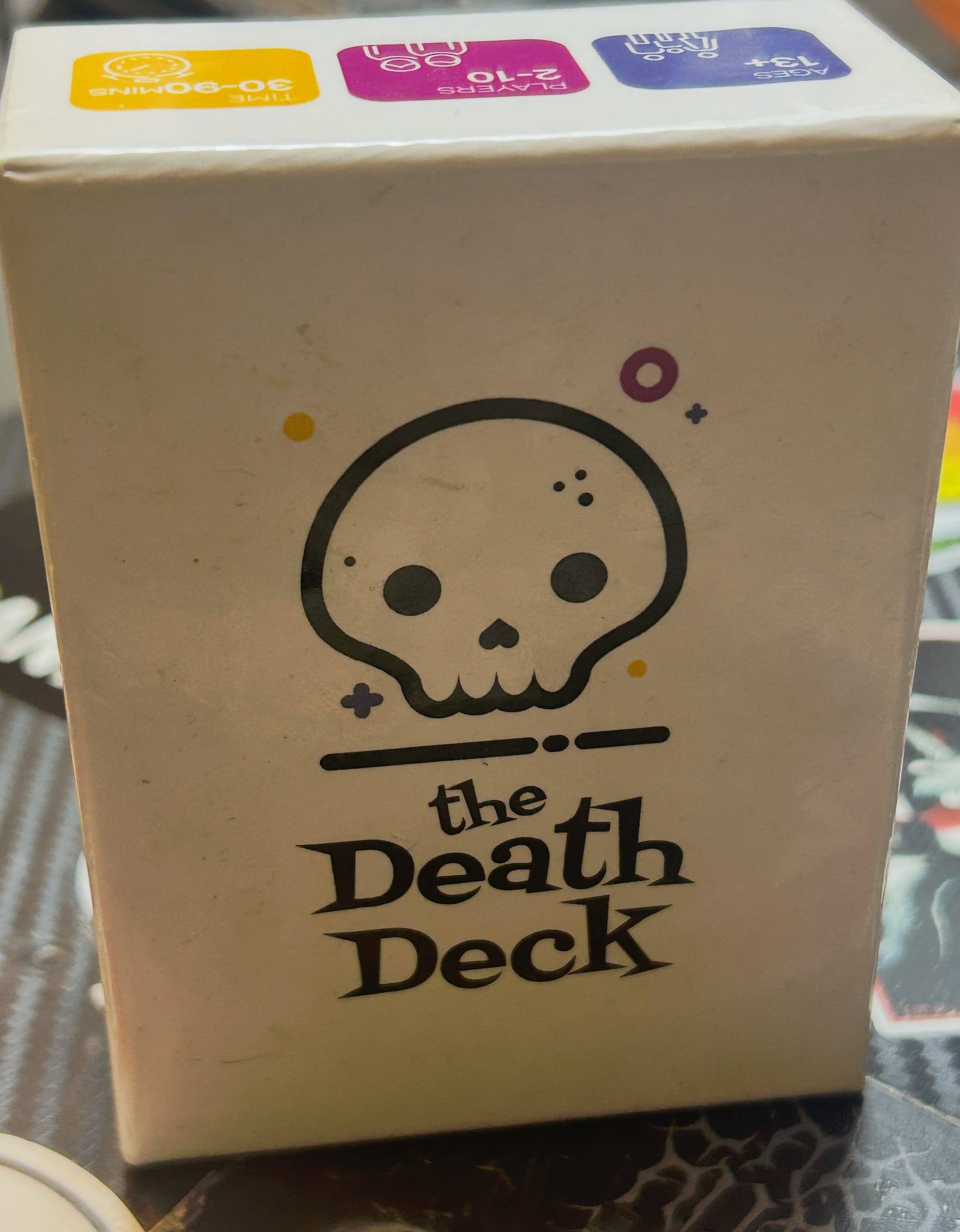
Pahl’s game, The Death Deck, uses multiple-choice cards and open-ended discussion questions to examine players’ feelings about death and dying, the legacy they wish to leave and their understanding of end-of-life care options like hospice, as well as their beliefs in things like ghosts or an afterlife, among many other topics.
I had the idea of convening a group of hospice and palliative care leaders to play this game with me. I wanted to see the kinds of conversations The Death Deck could stimulate. Also, quite frankly, I have owned this game for years, and no one has ever been willing to play it with me – a testament to how uncomfortable the subject matter is to many people.
The group that came together to do this was fantastic. They were open and forthcoming. They brought the full measure of not only their expertise in the field but also the full measure of their humanity, lived experience and hopes for the future.
Some aspects of the game were deeply personal, so I am not going to quote the participants by name when I reference those portions, out of respect for their privacy. However, I definitely want to extend my sincere thanks to hospice and palliative care physician Dr. Michael Fratkin, Hospice News Senior Reporter Holly Vossel, Mettle Health Co-Founder Sonya Dolan and Altonia Garret, COO of the hospice provider Blue Ridge Care. I also answered the questions.
We played for one hour and kind of wanted to keep going, but our duties called. We followed that with a brief Q&A about the experience.
Dealing with death growing up
The first question we encountered was multiple choice — Growing up, my family dealt with death:
a) By talking openly, sharing feelings, stories, and dark humor
b) In a no-nonsense sort of way, sh*t happens, you move on
c) Keeping it all bottled up and avoiding any discussion.
Not all of us fit neatly into one of these three categories, but the question did foster a good discussion. Here are some excerpts from the responses:
“I have had a lot of deaths over my life. As a child, there wasn’t a lot of discussion. It’s very rooted in faith, and ‘on to the other side,’ and transition in the celebration of life, all of that. So it’s kind of like when it happened, it was joyous. It was sad, sure, but we recognize that folks are going to join the ancestors, and it’s a celebration of this life that was lived … but there wasn’t a lot of talk about it, though, and not a lot of talk leading up to the death.”
“It’s definitely, ‘C: keeping it all bottled up and avoiding any discussion.’ I know after my brother died, I was afraid to mention his name to my parents, because it would upset them so much. And I actually had a cousin, John, who died the same way. He was shot at age five, and after the funeral, family members went through his parents’ house and took down all the photos of him off the wall, thinking they were being kind to remove a painful reminder, but it was almost like erasing him a little bit, and I find that kind of disturbing. So, definitely keeping it all bottled up was our approach.”
Imagining your mortality
One of the more open-ended questions we came across was, “Would you say that you imagine your death or the death of your loved ones more often?”
“I tend to be a person that worries about others more, especially with my parents. Full disclosure, I’ve been a full-time caregiver to both parents in different roles. They both have their own chronic conditions, and I started that too early, I think … I always worry about – for instance, my father, who doesn’t live anywhere near me – what could happen to him. It has happened, I have had to drop my life and abandon [my colleague] for a week, and go down to Florida to care for him. I worry what would happen if he could die without me present.”
“I deal with a lot of worry that I’ll get the illnesses that my patients get. So lately, I’ve been feeling anxious about ALS, because I’m working with a couple of guys with ALS, and what if that happens to me. I always think if there’s something at the sort of boundary of empathy that I sometimes absorb anxiety for it. So I thought about it a lot long before I had a family, and now that I have a family, I think about my children and my wife. When she gets a pain in her tummy or something like that, I am kind of more anxious than I might look on the surface.”
“When I was little, I would actually do very deep dives into what would happen if my parents died. I [would] really, really think about it, and to the point of sobbing. But I think it was a really good exercise of just what is it to experience loss or think about loss … My mom did die in my 20s, and she was like fully my person, and that’s why I’m even here in this space doing this work. It is because of that, but I think her death really opened for me that this is around all the corners, if she – someone who is healthy, someone who didn’t have any crazy, dangerous habits – has died.”
Sharing your feelings
Another multiple choice question we considered was this – “How often do you let the ones you love know how you feel?”
The options were:
Very rarely, I’m not one to share my feelings
Fairly often, in the right moments and on the right occasions
Constantly, and they’ve asked me to stop.
Here are a couple of the answers:
“I’d say for me it would be ‘c’ – it’s constant, but they haven’t asked me to stop. When I talk to my daughters or my grandson, it’s the first thing that I say. ‘Hi, I love you.’ That’s how I lead, and I’m saying, saying those words to friends and people all the time. I feel like death is always in the room, whether we like to think about it or not. Anything we do or say could be the last thing we do or say. So, I think a lot about what I want those words to be, what I want those actions to be. Do I want it to be something selfish, unkind or angry? Hopefully not. So, yeah, I do kind of constantly tell them how I feel.”
“I am squarely in ‘c.’ I do it a lot. I make a point to do it. I do a lot of texting of people just out of the blue to tell them I’m thinking about them and what I appreciate about them, or what I love in my relationship with them. This is the thing that I have to give, my love and care and attention. Why would I not do that on a daily basis, and let people know how I’m feeling?”
Coda
These are just a handful of examples of the topics we covered, but I think they make a solid representative sample. At the end, everyone seemed to agree that playing the game had been a positive experience that generated some food for thought about how we feel, what we want and what we need to do (like, for some of us, documenting our health care wishes). This was a thought-provoking and fun exercise, and I got to know some great people just a little bit better.
“Death is always in the room.” “This is around all the corners.” We need to talk about this thing that we all must confront and stop treating it as a dirty little secret.
I also think that awareness of our mortality and its potential imminence can bring out our softer edges, something that may be sorely needed in today’s world.
What do you think? Would you play a game like this? Do you talk about these issues and concerns with your loved ones?
I really appreciated this article because it highlights something our society desperately needs: we have to stop treating conversations about death as something to avoid until a crisis forces them upon us.
Where I would offer a different perspective is on the idea of using games as the primary vehicle for these conversations.
While games may lower the barrier for some people, they can also unintentionally frame death as an activity to complete rather than a human experience to share. The most meaningful conversations I've witnessed have never started with cards or competition. They began with people simply sitting together, listening without judgment, and giving one another permission to speak honestly.
That is why I believe the Death Café movement deserves even greater attention.
Death Cafés are intentionally simple. There is no agenda, no expert teaching the room, no expectation that anyone will arrive at a particular conclusion. People gather over coffee or tea and talk about mortality, grief, caregiving, fear, hope, legacy, and love. In that space, something remarkable happens: death becomes less of a taboo and more of a shared human reality.
As someone deeply involved in hospice care and developing educational programs around compassionate end-of-life care, I've seen how powerful these conversations can be. When people are given a safe environment to tell their stories, ask difficult questions, and simply be heard, the walls surrounding death begin to come down naturally. There is no need to gamify what is already one of life's most profound experiences.
If our goal is to create a culture that is more comfortable discussing mortality, then we should invest in spaces that prioritize presence over performance and conversation over mechanics.
Games may open the door for some, and they certainly have a place. But I believe Death Cafés open hearts.
Ultimately, what people need most isn't another activity—they need permission. Permission to ask. Permission to cry. Permission to laugh. Permission to remember. And permission to talk openly about the one experience every one of us will eventually share.
That is where real cultural change begins.