

Hi everyone!
Sorry if I got a little sarcastic last week in my post about the moratorium extension. I wrote it at night in a hospital waiting room, and I wasn’t in the best mood. I stand by 99% of what I said. I just perhaps should have been a little less snarky. Perhaps “Oh for crying out loud,” wasn’t the best way to start the piece.
Moving on, I had a great conversation a few days ago with Ted Kenny, an 81-year-old hospice volunteer who works with Treasure Coast Health in Florida. Ted told me that hospice is his passion, and his mission is to help people better understand those services and reduce the surrounding fears.
That was the impetus behind Ted’s new book, “Hospice Is Not A Dirty Word: What Hospice Taught Me About Living, Dying, and Everything in Between.”
It was an honor to speak with someone who has given so much to hospice patients. I really enjoyed the discussion.
Here’s how it went:
How did you become a hospice volunteer? What led you to this?
It’s something that is a passion of mine, plain and simple, and that sounds sort of crazy for an 81-year-old to be thinking that way.
My best friend died when he was 42. And we spent the last six months of his life together almost every day either by phone or in person. I got to know death. I got to know cancer, and I got to know all the things. I don’t want to say I was comfortable, but I was at ease. I got it.
I used to have to drive him in and out of the city because he had had so much chemo that he couldn’t ride the subways or anything. So we’re in the car and we’re coming home, and I said, “Cancer, cancer.” And he goes, “What are you talking about?”
I said that It doesn’t bother me. It’s part of our friendship. We sat in front of his house for an hour talking. He just unloaded, because he kept it all inside, and I just, that kind of got me going on it.
When I started volunteering over 18 years ago, I found that I could sit down and talk to people about death. I could talk to them about hospice. I could talk to them about just about anything, and I’ve been involved in so many incredibly philosophical conversations with somebody that’s dying.
If people understood how incredibly good hospice is and what we can do for people, that’s what I’m trying to do. I’m not trying to sell books per se. All the money goes back to the hospice. I am just trying to educate people and get them understanding and making them just a little more comfortable.
What were your early days like as a volunteer?
Well, when my died, I wanted to do it right away, and that was at the very beginnings of hospice in the United States. But they said, “No, you can’t.”
Then I did something crazy. I was working on Wall Street at the time. Two weeks before he died, we were sitting in his bedroom talking. I have three kids. He had three kids, and he goes, “I will never let my little girls see my little girls grow up, and you will not see your kids grow up again.”
And I realized that I was working like a madman, going crazy, and eight months later, I quit. I got to know my wife and kids. It’s been a journey, and it really changed my life, and I thank him for it.
Finally when we were in Colorado, I said, “I gotta do this, and I went over to a place called Porter Hospice, which is part of Adventist Health. I went to work in an 18-bed inpatient unit, and that’s where I learned how to do it.
What did you do in that capacity at the inpatient unit?
Well, it’s kind of funny because here, a patient, one nurse has four patients. And there, we had two nurses, one CNA, and two volunteers for 18 patients.
So, I was put to work, and the one gal I worked with loved to answer the phones and kind of work in the office, nurses station, so to speak.I started roaming the halls. I would just come in and say, “Can I get you anything? Can I do something for you? And all of a sudden, one day, somebody goes, “Can we talk?” Then I was off to the races. I was able to do that.
As the staff got to know me better, they trusted me more. They would say, “Hey, this guy’s here. Can you help him? This woman has got this problem or whatever, not physically, but emotionally.” I’d sit down and talk with them.
When you’re actively dying, that’s the people that I’m really involved with for the most part. Sometimes they’re comatose; sometimes they’re not. But I then kind of switch over to the family and try to help them.
When I walk in, I size up the room. What do I see? Pictures, flowers, crucifix, whatever, and I’m trying to figure out how I am I going to approach this.
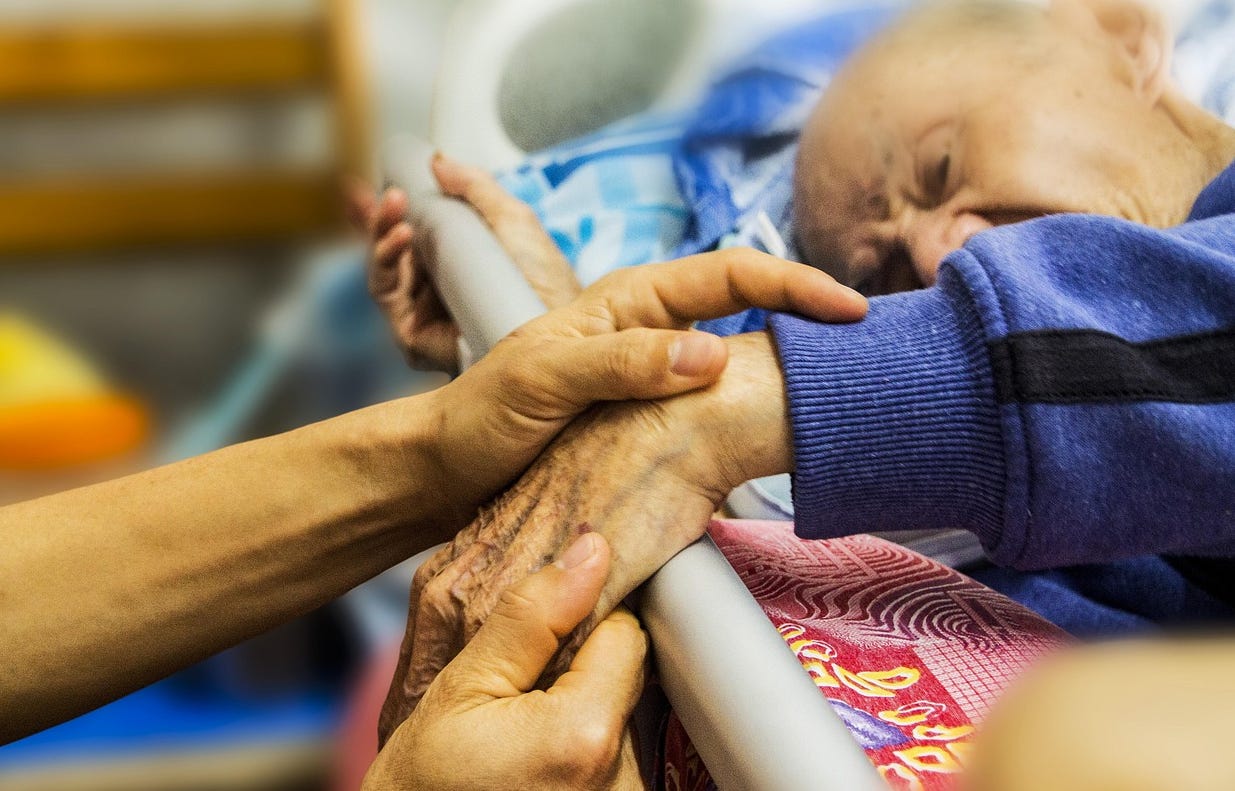
I just sit down. I give hugs. I hold hands, I just try to make them feel better, try to help them through this part of the journey.
Can you share one of your experiences with a dying person or their family?
I had a neighbor down the street whose husband died. For the last two or three days, I was down there pretty much nonstop. I was watching him, and I was telling her what was happening.
She said that was the nicest thing that could happen. She was scared to death not knowing what was going to happen. I kind of just told her what was going to happen.
I get very involved. I love to go in and just help people, really get down and dirty. It seems to work.
I’m very comfortable doing that. I walk out of there humbled,that these people would trust me enough, in a matter of moments, to really open up big time.
I see really cool things, loving families, and I see horror shows. I see everything that could possibly go on, and that’s fine. Everybody does it differently.
What would you say are the most important things you’ve learned while doing this work?
I’ve learned to listen more than anything. When I walk into that room, it’s not about me. I am just taking these people at face value and saying, “How can I work with you?”
I learned how to really listen, to look at people intensely. And sometimes I might talk to somebody for an hour, concentrating on everything. Quite frankly, it’s exhausting.
Sometimes, I work a four-hour shift on Monday mornings from 8:00 to 12. And I’ve come home and had to take a nap, because I’m exhausted. But that’s cool. That’s that’s what you’re supposed to do.
The other thing I’ve learned is about people. I’ve seen some beautiful people, I’ve seen some ugly people. And you learn that that’s part of our world. I derive a lot of benefit out of being a hospice volunteer.
What inspired you to write your book?
The frustration, so many times people come in to us, many of them have been with us, but an awful lot of them come in at the last moment. We have 650 patients in our care, in our hospice right now. We have over 400 employees to care for them.
It’s sad. Just picture, you’ve been through chemo, you’ve been through everything. They have put you through the wringer. Everybody says, “Let’s just try one more thing.” And these people are just beat up.
But they come to us with two or three days left in their lives. If we could get earlier in the process, we would help them in so many ways.
What do you hope people will take away from the book?
I want people to see hospice as something like, “Wow, those people are great. How can we get in touch with them?”
I had a great friend a couple of years ago, and we used to go out to breakfast every Saturday morning. I’d tell him about it in my book. His wife had died. He was probably going to die.
I just wanted to check on him, and then all of a sudden he said to me, “Let’s talk about hospice.” So we brought him into hospice with about two-and-a-half months to go.
Can you imagine 400 people that have just one thing in life? That’s to help people pass peacefully. That’s 400 people. Everybody has the same job, so to speak. We’re not diversified. We have one goal in mind — to make people as comfortable as we can.
And in the book, I really want people to understand that. We put our arms around them. I always say to people when they come in, “You’re in our house. You’re our guest, and we’re going to make sure we do everything we can do for you.”
That’s what I’d like them to understand. I want to take away this stigma for this bad word called hospice.
----
I hope you will all join me in thanking Ted for his work and extend that gratitude to all hospice volunteers. How does your organization show its appreciation for people like Ted who give so much of themselves? Please drop a comment.