

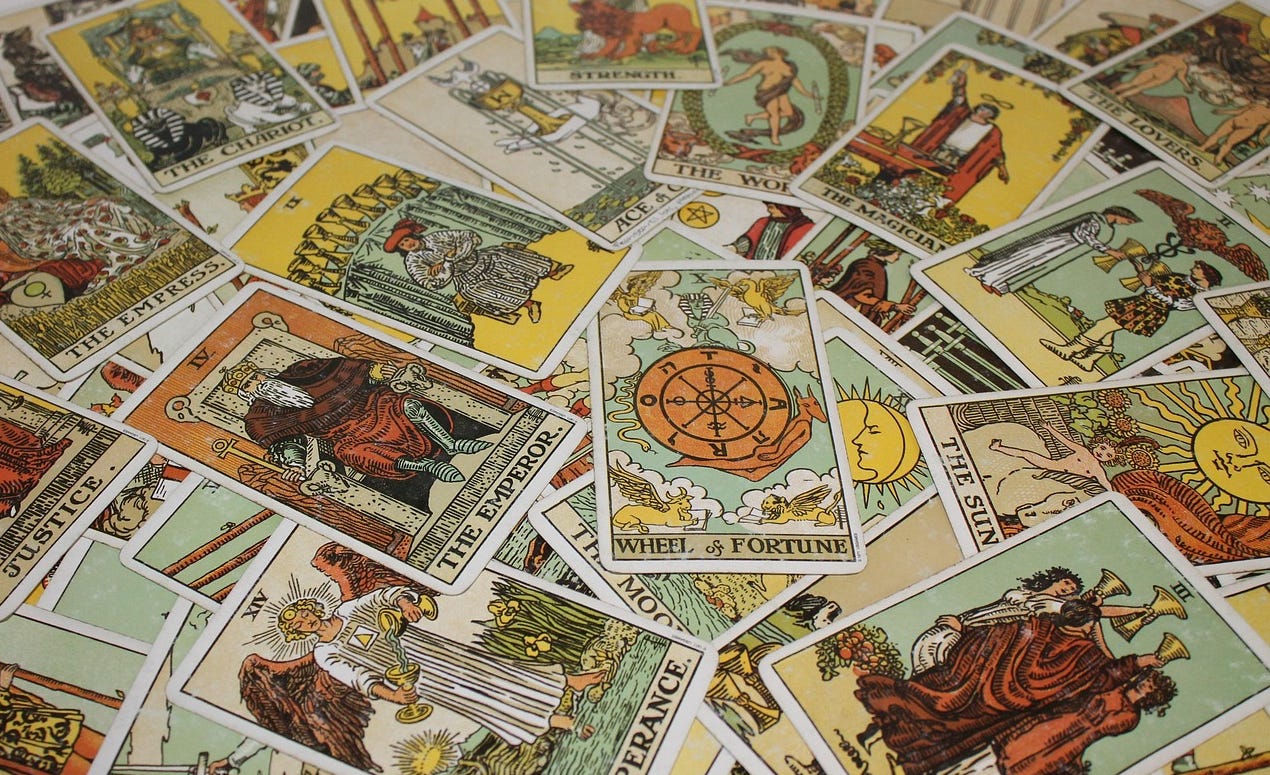
Fun fact: I dabble in tarot card readings. I really do it just for the occasional friend. Most often, I do readings for myself.
I don’t believe that the cards hold supernatural powers, nor do I think they can prognositicate much of anything. However, I do think they can be useful tools for self-reflection. They can raise new questions or help one see a situation from a different perspective.
So I thought I would do a reading for the hospice community, just to see what happens. I asked the question, “What’s in the cards for the hospice community?” and then I drew three cards.
A typical three-card spread in the tarot can be interpreted in a number of ways. I choose the rubric in which the first card represents a situation, the second a necessary action, and the third an outcome.
Here’s what came up:
Eight of Swords (The Situation)
The Eight of Swords symbolizes mental barriers, perceived limitations, and a sense of powerlessness, according to a number of guidebooks. The card is commonly interpreted as suggesting that many obstacles may be psychological rather than insurmountable, with a shift in perspective viewed as the first step toward overcoming them.
I wouldn’t quite say that hospices are “powerless” these days, but it’s true that hospice providers sometimes are sidelined and can feel a sense of being at the mercy of regulators, payers and other players in the health care sector. For example, CMS tying palliative care to the home health benefit in the recent prospective payment rule excludes hospices that aren’t Medicare-certified in home health.
However, many hospice providers are undergoing shifts in perspective that could help them overcome limitations. In particular, providers are expanding their mindsets to become more diversified organizations.
One key aspect of this is providing upstream care. More hospices are providing services earlier in the patients’ disease trajectory, like palliative care, PACE, home-based primary care and home health care, among others.
This trend exists across the nonprofit/for profit barrier. Many hospices in both sectors are reinventing themselves as a continuum of care that can begin far upstream of the end of life.
Another arena for reinvention is value-based care. While hospice care itself is largely excluded from those programs, providers in the space are still working to test some newer value-based models, often through the aforementioned upstream services.
Examples include these mouthfuls of words from the U.S. Centers for Medicare & Medicaid Services (CMS): the Accountable Care Organization Realizing Equity, Access, and Community Health payment model and the Guiding an Improved Dementia Experience (GUIDE model). A wide range of hospices are participating in these programs and pursuing innovations like specialized dementia care services as a result.
King of Wands (Necessary Action)
The King of Wands is commonly associated with visionary leadership, charisma and entrepreneurial ambition. In traditional tarot interpretations, the card represents the ability to channel passion and creativity into focused, purposeful action. It is often seen as reflecting a confident, decisive approach to pursuing goals and leading others.
This almost seems self-explanatory. In order to pursue innovation and invention, hospices have to be bold and take calculated risks. A PACE program can become a lucrative business that provides excellent and much-needed care for its participants. However, operators have told me that such programs typically take up to three years to break even. To invest in such a program, a hospice has to have a careful plan to foster sustainable growth but also exhibit confidence to launch into new models that do not have an immediate payoff. In other words, they need to have a vision.
To drive change, hospice leaders must both put on their thinking caps and roll up their sleeves, determine what is achievable, the resources and people they will need, and have plans for the potential outcomes.
Hospice might not be the biggest, most powerful healthcare sector, but the passion of hospice providers give them tremendous power, if they have the confidence to break new ground.
Page of Pentacles (The Outcome)
The Page of Pentacles is commonly associated with the beginnings of new endeavors, financial opportunities and a willingness to learn, so there’s a good deal of symmetry among the three cards.
In traditional tarot interpretations, the card represents the early stages of developing skills, pursuing tangible goals, or exploring new ventures. It is often viewed as encouraging careful planning, steady effort and a long-term approach to personal or professional growth.
Of course, life is not as simple as the cards make it sound. It takes courage to do something new. A hospice can do all the right things in pursuing a new venture and still struggle or even fail. The unexpected happens and “X” rarely marks the spot.
That said, the health care world is changing, and hospices may want to think about the ways they can change with it. Success will require visionary leadership, effective planning and a lot of grit. But the cards suggest that if hospices adopt a start-up mentality today – that is, a blend of entrepreneurial innovation and the humility to learn lessons along the way – but are committed to playing the long game, they will be rewarded.
What are some of the ways you see the hospice world changing? Please drop a comment.
This is so awesome. I love the cards myself! Love the interpretations as they relate to hospice.